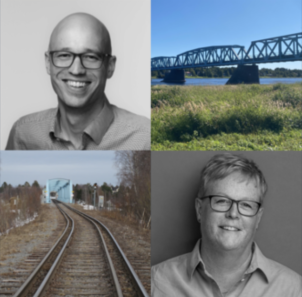

The bridge between Sweden and Denmark has been the subject of much writing and, in many parts of the world, has almost become synonymous with the very word ‘bridge’ thanks to the popular crime series. Let us tell you about a somewhat lesser-known bridge and an exciting cross-border project: the railway line between Laurila and Haparanda, featuring the bridge over the River Torne, which was built in 1919 and connects Haparanda in Sweden with Tornio in Finland.
The Öresund Bridge. The Svinesund Bridge. The bridge over the Torne River. There is something beautiful and symbolic, almost poetic, about cross-border bridges. Bridges that unite and foster encounters and trade between people, whilst enabling new traffic flows and patterns of behaviour.
As a resident of southern Sweden, one perhaps doesn’t give much thought to the land border between Sweden and Finland. When you visit Haparanda and Torneå – or Tornio in Finnish – you’re struck by how imperceptible and natural the transition feels. The towns have practically grown together, and you can move freely across the border, at least on foot or by car. Somewhere between Ikea and the Rajalla shopping centre, you realise that the signs have switched languages.
Untapped potential is unleashed
When it comes to the rail link, however, the situation is different, and there are a couple of major obstacles. Firstly, the countries have different signalling systems, at least until ERTMS is fully rolled out in both countries. Furthermore, the track gauge differs: 1,435 mm in Sweden compared with 1,524 mm in Finland.
There is, admittedly, a railway line between Haparanda and Tornio, but it is not in a particularly competitive condition at present. Above all, it is not electrified, so services must be operated using diesel locomotives. Consequently, traffic volumes are fairly modest in terms of both passenger and freight services. The issue of different track gauges has been resolved by having the final kilometre to Haparanda built to both gauges.
What opportunities would upgrading this line create? Passenger services operate between Helsinki and Kolari, not far from Pajala. A connection to Swedish trains heading south would improve passenger services between towns such as Oulu, Kemi, Boden, Luleå and Umeå. The northern parts of Sweden and Finland also attract significant numbers of tourists. Freight could be transported across the border at a lower cost if the line were electrified, thereby eliminating the need for diesel locomotives. The North Calotte region boasts vast natural resources, and the port of Röyttä has the potential to grow. Upgrading the railway line therefore appears to be a relatively low-hanging fruit with considerable potential.
The good news is that this exciting project is already underway and is expected to be completed by 2024. Welado is participating in and leading part of the work on the project.
Matti is leading the work
In terms of infrastructure, the project may be seen as fairly low-hanging fruit, but one senses that, as with most projects, there are challenges to overcome. I spoke to Matti Tervonen, who is a project manager at Welado, to find out more about the work.
Matti, tell us about the project!
– The main task is to electrify 25 km of railway from Laurila to connect Finnish passenger trains to Haparanda, so that passengers can then walk across the platform to continue their journey southwards into Sweden. As part of this, we are upgrading the railway’s signalling systems and points, as well as refurbishing the bridge over the Torne River (Tornionjoki). Some track realignments are also being carried out.
What are we contributing?
– Put simply, we are supporting the Finnish transport authority in its project by ensuring quality and delivery in relation to the subcontractors. The Swedish Transport Administration is also involved, as it is responsible for the final kilometre into Haparanda station. We are providing a team that brings expertise in the form of project management, project engineers and specialists in signalling, risk and safety.
What challenges have you encountered?
– The biggest challenge, and perhaps the most obvious one, is that this is a cross-border project. The sections of the line located in Sweden have a different ownership structure and different regulations and processes regarding maintenance and approvals. That is why the Swedish team member on the project is so important.
Matti explains that the project began this year, 2022, and is now in the design phase. Next year, the construction phase will begin, followed by approval and completion by the end of 2024.
Ellinor is the point of contact with the Swedish authorities
As Matti mentioned, the project has a member of staff from the Swedish side, namely Ellinor Karlsson at Welado’s office in Örnsköldsvik.
Ellinor, what is your role in the project?
– As this is a cross-border project, we need someone with knowledge of approvals and processes within Swedish authorities, primarily the Swedish Transport Administration and the Swedish Transport Agency. There are certain documents and permits that must be in place. And, of course, it makes things easier to communicate with Swedish authorities in Swedish.
In conclusion, we note that it will be very interesting to follow this project going forward and see how the area develops. Infrastructure and the railway are of great importance and create the conditions for the area’s development. For us at Welado, the project also carries strong symbolic significance, namely the collaboration between the companies. And Swedish-Finnish friendship.